How Many Stations Does an Outdoor Gym Need?
There is no single right number. How users, peak hours, clear space, shade and site type decide how many outdoor gym stations fit your site.
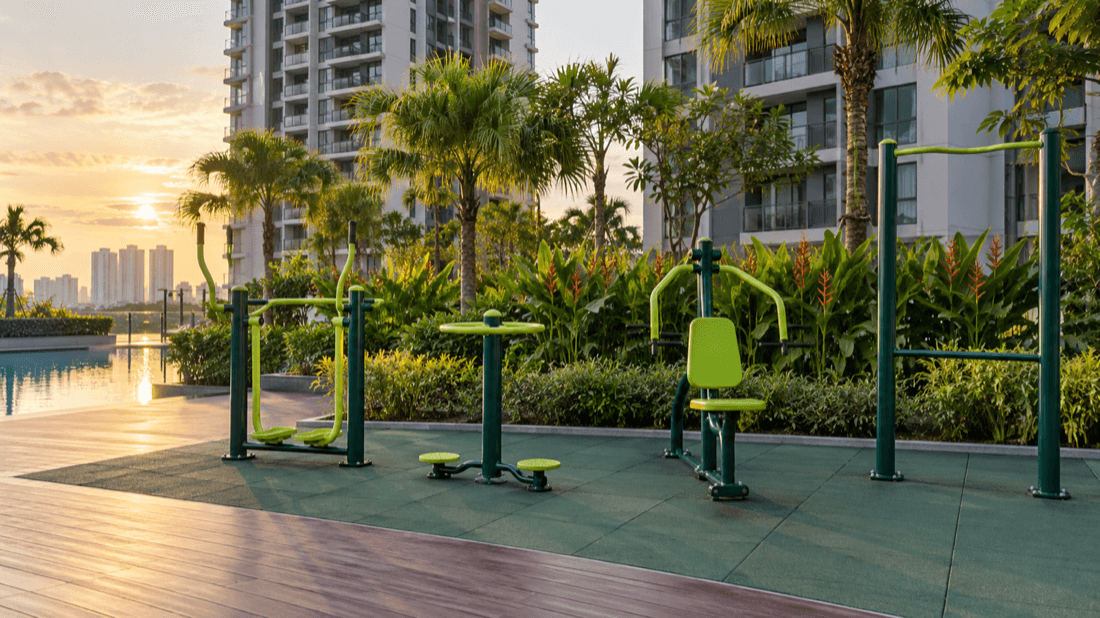
One of the first questions people ask when planning an outdoor gym is how many stations it should have. It sounds like a simple number, but the honest answer depends on the space, the people who will use it and what you want the area to do. A neat corner of a few well-chosen stations often gets more use than a long row of equipment squeezed into a space that cannot hold it.
This guide walks through the factors that decide the right size for your site, so you can arrive at a station list that fits rather than one picked out of thin air.
Start with the people, not the equipment
Who will use it, and when
Think about the residents, students or guests you expect to see at the stations. A condo podium used mostly by working adults in the evening has a different rhythm from a neighbourhood park where retirees gather at dawn, or a school field where a whole class may arrive at once. The busiest hour matters more than the daily total: if several people tend to turn up together, the area needs enough stations that nobody stands around waiting.
What kind of exercise they want
Some groups want gentle mobility work, others want strength training, and many sites need a bit of both. A small set that covers walking motion, hip rotation, pushing and pulling already gives a balanced routine. If you are unsure which movements to lead with, our comparison of the air walker and waist twister is a good place to start.
Mixed-age sites
Where children, adults and older residents share one space, it can help to think in small zones: a gentle cluster near the shade and seating, and a strength cluster with a pull-up station or combination station a little further along. Each zone can be modest on its own.
Let the space set the limit
Clear room around each station
Every station needs space for its own movement, plus room for people to step on and off safely and to walk past without getting in the way. Swinging legs on an air walker and outstretched arms on a seated press both take up more room than the frame suggests. Your supplier or contractor can advise on the clear area each station needs; it is better to fit fewer stations with proper spacing than to crowd them.
Ground, shade and drainage
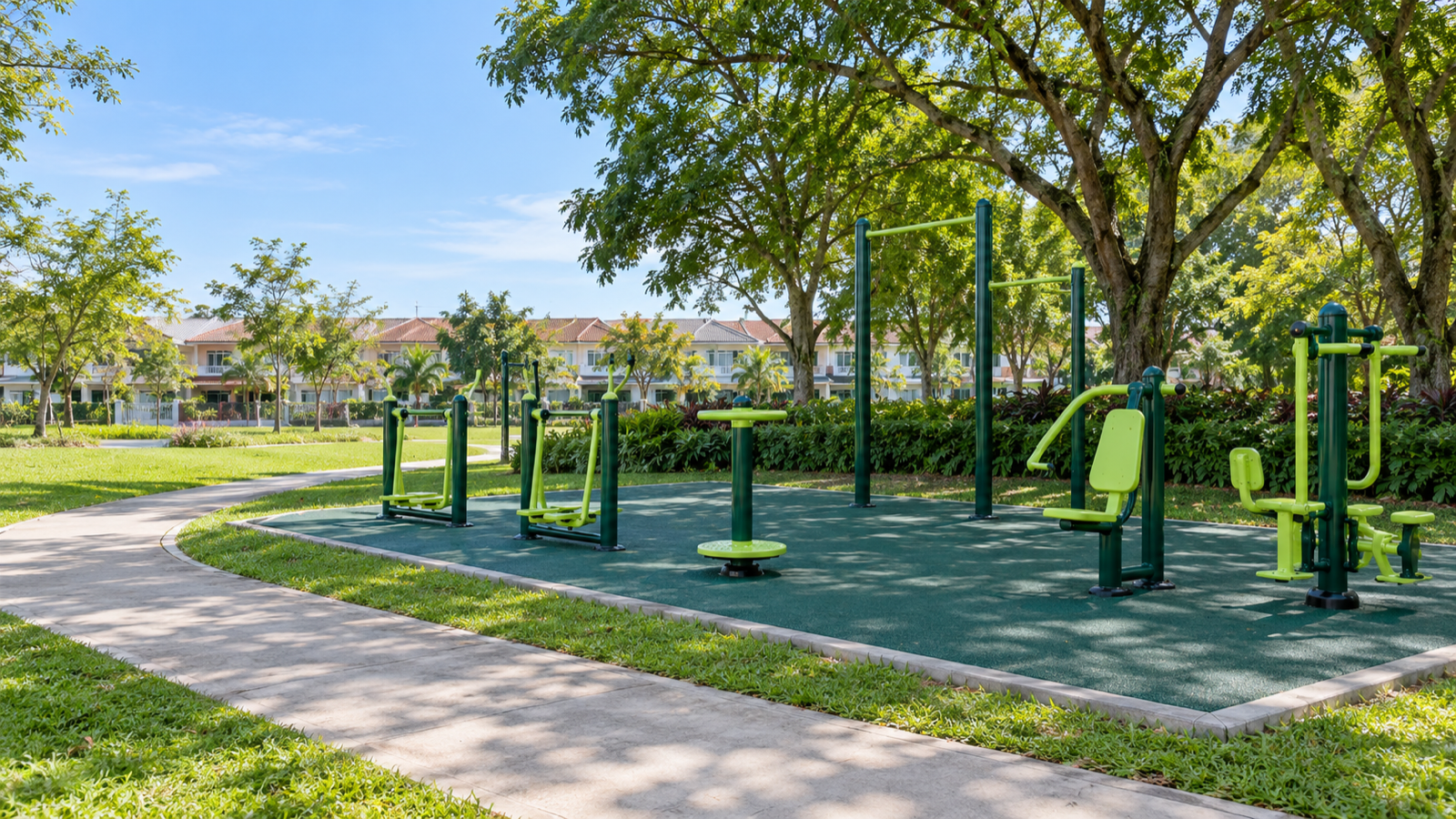
The usable area is often smaller than the plot on the drawing. Tree roots, drains, slopes, pathways and spots that flood after heavy rain all take space off the table. In Malaysia, shade also shapes the layout: a cluster under mature trees may be more valuable than a larger area in full sun that nobody wants to use at midday.
Anchoring and surfacing
Each station has to be fixed securely, either with base plates bolted to existing concrete or with posts set into new concrete footings, and the ground around it needs a suitable surface such as poured rubber, interlocking rubber tiles or an existing hard surface. Both affect how many stations make sense in one go, because the groundwork is part of the job. Our article on how stations are anchored explains the options.
Matching the size to the site type
Condo podiums and gated communities
Podium decks are often tight, with planters, pool areas and walkways competing for space. A compact cluster near the existing landscaping usually works better than spreading stations across the deck. Developers in fast-growing areas such as Johor Bahru and Shah Alam often weigh this against the other facilities residents expect.
Public parks and jogging trails
Parks have more room, so the question becomes how to spread stations sensibly. Some councils prefer one central fitness corner; others place small groups of stations along a jogging trail so runners can stop at intervals. Planned townships such as Putrajaya, with long lakeside paths, suit the second approach well.
Schools and resorts
Schools need to think about class sizes and supervision: stations grouped where a teacher can see them all are easier to manage. Resorts usually want fewer stations placed with care along a garden path, where they add to the guest experience without dominating the view.
Building in room to grow
Start with a core set
If budget or space is uncertain, it is reasonable to begin with a core set covering the main movements and leave space for more later. Plan the surfacing and layout so additional stations can be added without tearing up what is already there.
Watch how it is used
Once the stations are in, notice which ones always have a queue and which are rarely touched. That real-world pattern is the best guide to what to add next, and it is often different from what anyone expected on paper.
Getting a station list for your site
Rather than guessing a number, send us what you know: a few photos of the area, its rough size, who will use it, what the ground is like today, how much shade it has and your timeline. We will suggest a station list and layout for you to review, then you confirm the stations, anchoring and surfacing before installation is arranged. Browse the outdoor gym equipment range to see the station types, and when you are ready, message us on WhatsApp to get started.