How Outdoor Gym Stations Are Anchored: Base Plates or Footings
Base plates bolted to existing concrete or posts set into new footings: how each anchoring method works and what to check on your site first.
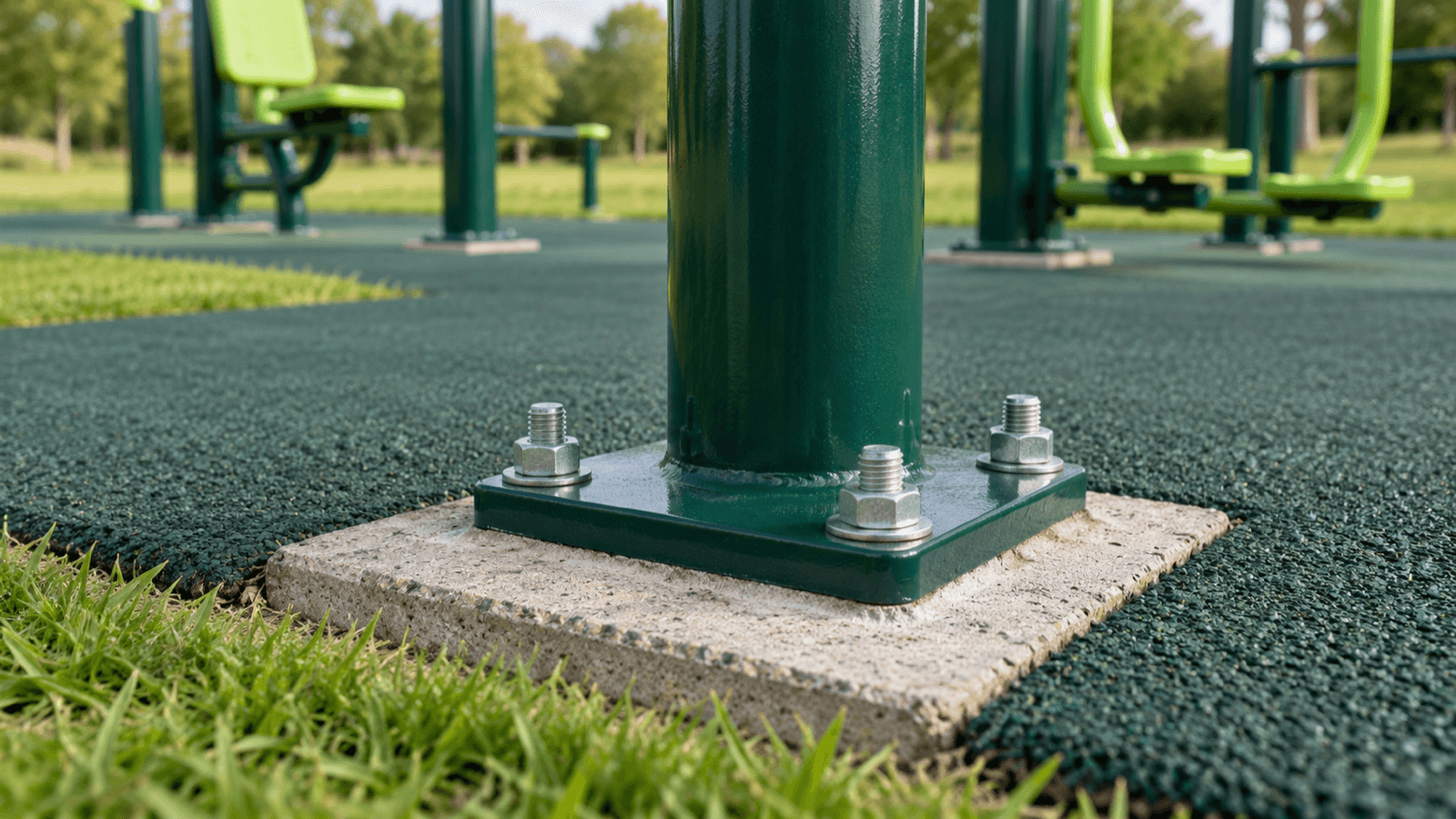
An outdoor gym station takes a lot of force. Someone swings hard on an air walker, a group pulls on a combination station at the same time, a teenager drops from a pull-up bar. All of that load ends up in the ground, so how each station is fixed down is one of the quieter but more important decisions in the whole project.
There are two anchoring approaches we usually discuss with buyers: base plates bolted to existing concrete, and posts set into new concrete footings. This article explains how each works, where each tends to fit, and what to check on your site before choosing.
Option one: base plates on existing concrete
How it works
Each post finishes in a flat steel plate at its foot. The plate sits on an existing concrete slab and is fixed with anchor bolts drilled into the concrete. Nothing needs to be dug up, so the station can stand on a slab that is already there, such as a podium deck, a plaza, a paved corner of a park or a concrete strip along a jogging track.
Where it fits
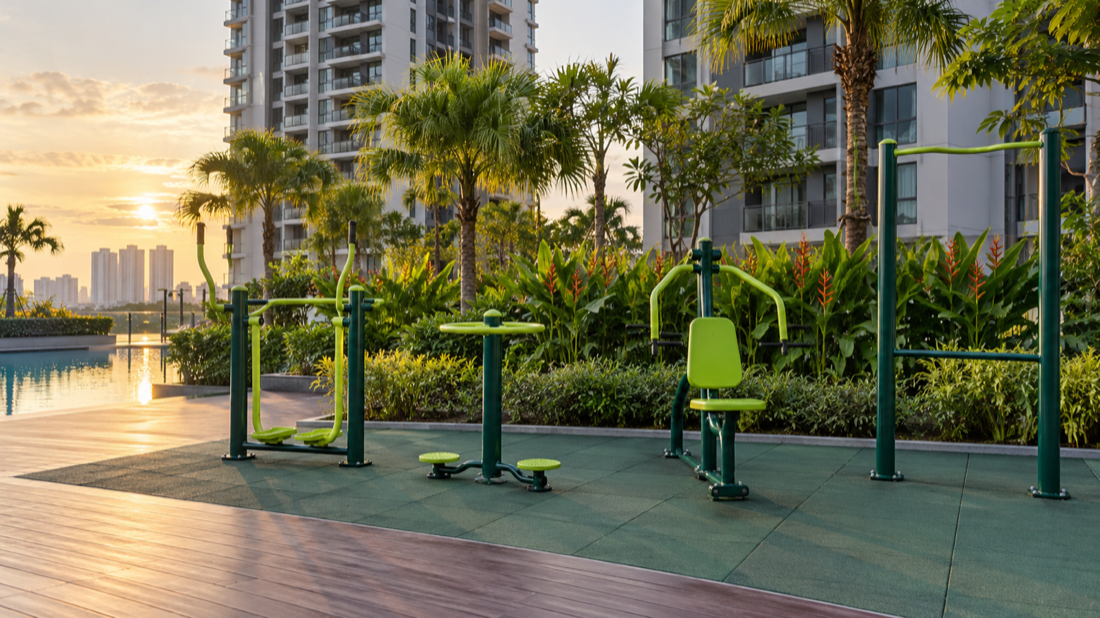
Base plates make sense when good concrete already exists and you would rather not break it. Condo podiums are the classic case: the deck is built, landscaped and often sits over a car park, so excavating is not an option. Base plates also suit places where you want the work on site to be short and tidy, with less disruption to residents or visitors.
What to check first
The slab has to be thick and sound enough to hold the bolts. Cracked, hollow or thin concrete is a warning sign. On a podium deck there is usually a waterproofing layer and possibly a planter or drainage system beneath, so drilling must be planned with the building's engineer or management, not done on assumption. Ask for this check before the layout is final.
Option two: posts set into new concrete footings
How it works
Here a hole is dug for each post, the post is set in position, and concrete is poured around it to form a footing below ground. Once the concrete has cured, the post is held firmly by the mass of the footing and the surrounding soil. Surfacing is then laid over the top so only the post shows.
Where it fits
Footings suit open ground: grass in a public park, soil along a school field, a new landscaped area in a landed estate. Where there is no slab to bolt to, they are usually the natural choice, and they leave a clean look at ground level with no plates or bolt heads showing.
What to check first
Before digging, find out what is underground. Water pipes, drains, electrical cables and tree roots all affect where a footing can go. Soft or waterlogged soil, common in low-lying areas after the monsoon, may need a different footing design. Your contractor or engineer should confirm the ground conditions; it is not something to guess.
Choosing between them
Start with what is already on the ground
The simplest question is often the deciding one: is there sound concrete where the stations will go? In a dense area such as Petaling Jaya, many sites are podiums, rooftops or paved courtyards, which leans towards base plates. In newer townships around Johor Bahru, a fresh landscaped park on open ground may lean towards footings. Older neighbourhoods in George Town can have a mix of both within the same space.
Think about the surface on top
Anchoring and surfacing are decided together. A base plate sits on top of the slab, so poured rubber or tiles have to finish neatly around it. A footing sits below ground, so the surface runs right up to the post. Our guide to choosing safety surfacing covers how each surface handles these details.
Mixed sites are normal
It is common for one outdoor gym to use both methods: base plates for stations on an existing path and footings for stations on the grass beside it. What matters is that each station is fixed in a way that suits the exact spot it stands on.
Questions worth asking
- Is there a drawing or record of the existing slab or the services under the ground?
- Who needs to agree to drilling or digging, such as building management, a council or the school?
- When can the area be closed off, and how long does it need to stay dry for concrete or surfacing work?
- How will the area drain once the stations and surfacing are in?
After installation
Keep an eye on the base
Whichever method is used, the base of each post is worth checking from time to time. Look for loose or rusting bolts on base plates, cracks in the concrete around footings and gaps opening up between the post and the surfacing. Malaysia's heat and heavy rain work on every outdoor joint, so catching small issues early keeps the station steady.
Plan your stations
See the outdoor gym equipment range to decide which stations you need, then send us photos of the ground where they will go. We will suggest an anchoring approach for each spot in the layout proposal. Just WhatsApp us your photos to begin.